
One integrity layer, every environment.
Gofai deploys as two containers — the Engine and the Console — into the environment your data already lives in. AWS, a private VPC, or on-premises hardware. Same software, same guarantees, wherever it runs.
The fit, the perimeter, the view.
Three things a technical evaluator needs to know before moving forward.

Zero data egress, by architecture
Every component Gofai needs, including AI inference, runs inside your environment. Your data, metadata, and inference traffic stay where they are. What crosses the boundary is nothing.

Reads the pipeline, changes nothing
The Gofai Engine reads your data at the points that matter and writes findings to storage you control. It is not in the write path. No schema changes, no new dependencies. Remove it and the pipeline runs exactly as it did before.

Every pipeline in a single pane
The Gofai Console shows pipeline health, findings awaiting steward review, and anomaly alerts across every pipeline at once, no matter how many environments are in play. Each pipeline keeps its own Engine; all report into one Console.
The same two containers, three ways to run them.
The Engine and Console are ordinary containers. Where they run is an operational choice, not something the product forces.

AWS
Available NowFor environments already operating in AWS. Gofai runs alongside an existing S3, Glue, and Redshift estate without requiring any re-platforming.

Private VPC
Available NowA private network in any cloud where Gofai runs inside that boundary under existing policies. The same guarantees hold regardless of the underlying provider.

On-premises
Available NowFor environments where data residency, air-gap, or regulatory rules require everything to remain in your own data center.
Hours, not days.
Three steps. No data migration, nothing to re-platform.
Deploy the two containers
Pull the Engine and Console images and run them on the platform already in use: ECS, EKS, EC2, Kubernetes, or bare hosts. No orchestration that is not already there.
Point Gofai at storage you control
Provide a bucket, blob store, or filesystem path for findings, logs, and audit records. Gofai brings no storage of its own and writes nowhere it was not pointed.
Grant scoped, revocable write access
Gofai reads the pipeline read-only and writes only to the location you provisioned. Revoke access at any time. That is the full extent of what Gofai requires.
Your perimeter keeps everything.
Every component Gofai needs to do its job, including AI inference, runs inside your environment. What crosses the boundary is nothing.
0 bytes
leave the perimeter
Data, metadata, and inference traffic all stay inside your environment. No phone-home, no telemetry calls, no hosted model API.
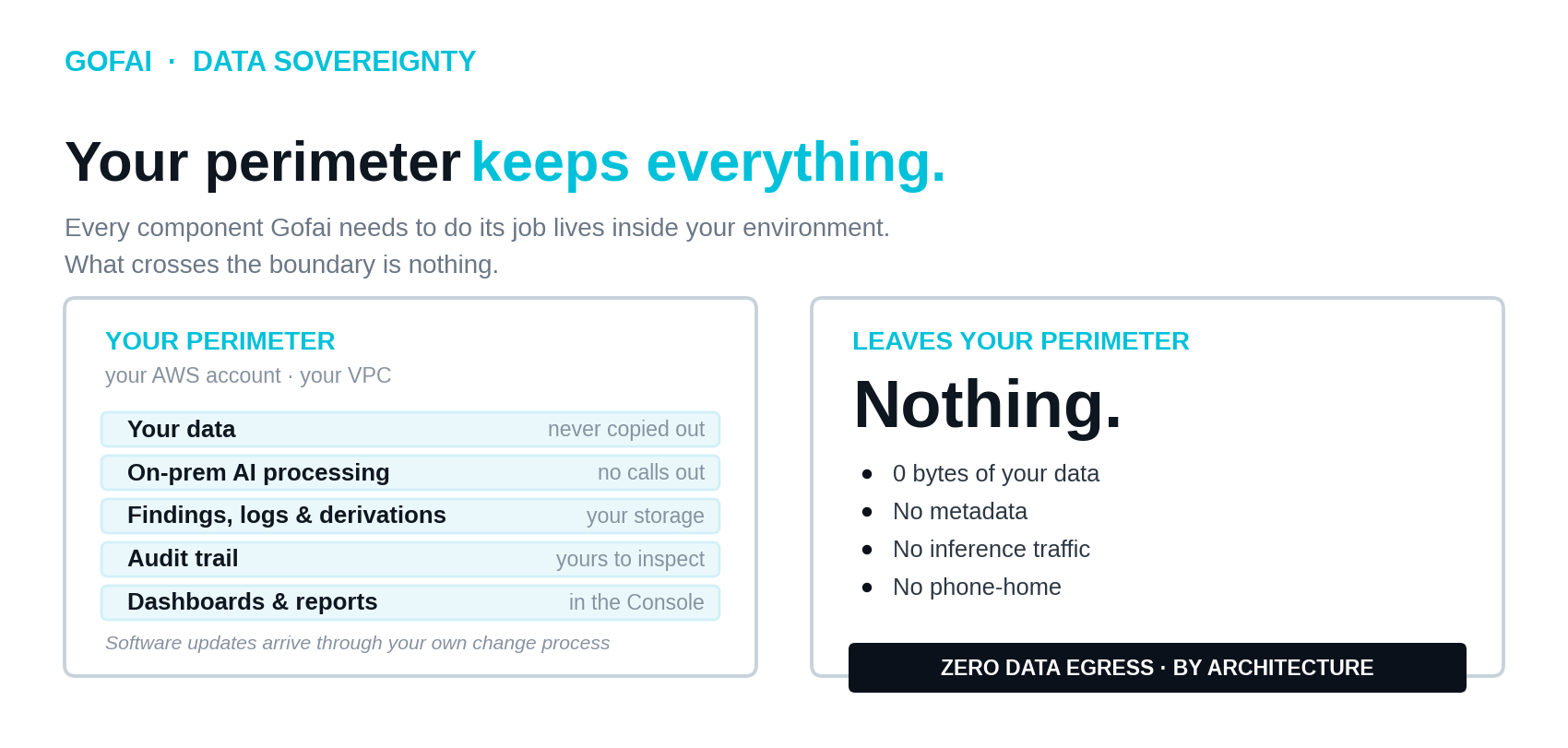
Most AI tools make outbound calls to hosted model APIs, telemetry endpoints, or vendor clouds that log usage. Gofai's AI inference runs locally in your environment using the same container that processes your data. There is no hosted API to call, no model update that phones home, and no shared-custody arrangement to account for. Software updates arrive through your own change process, the same as any other container you run. For engagements where a data-residency guarantee has to be made to the environment's owner, this is the architecture that makes the guarantee real rather than contractual.
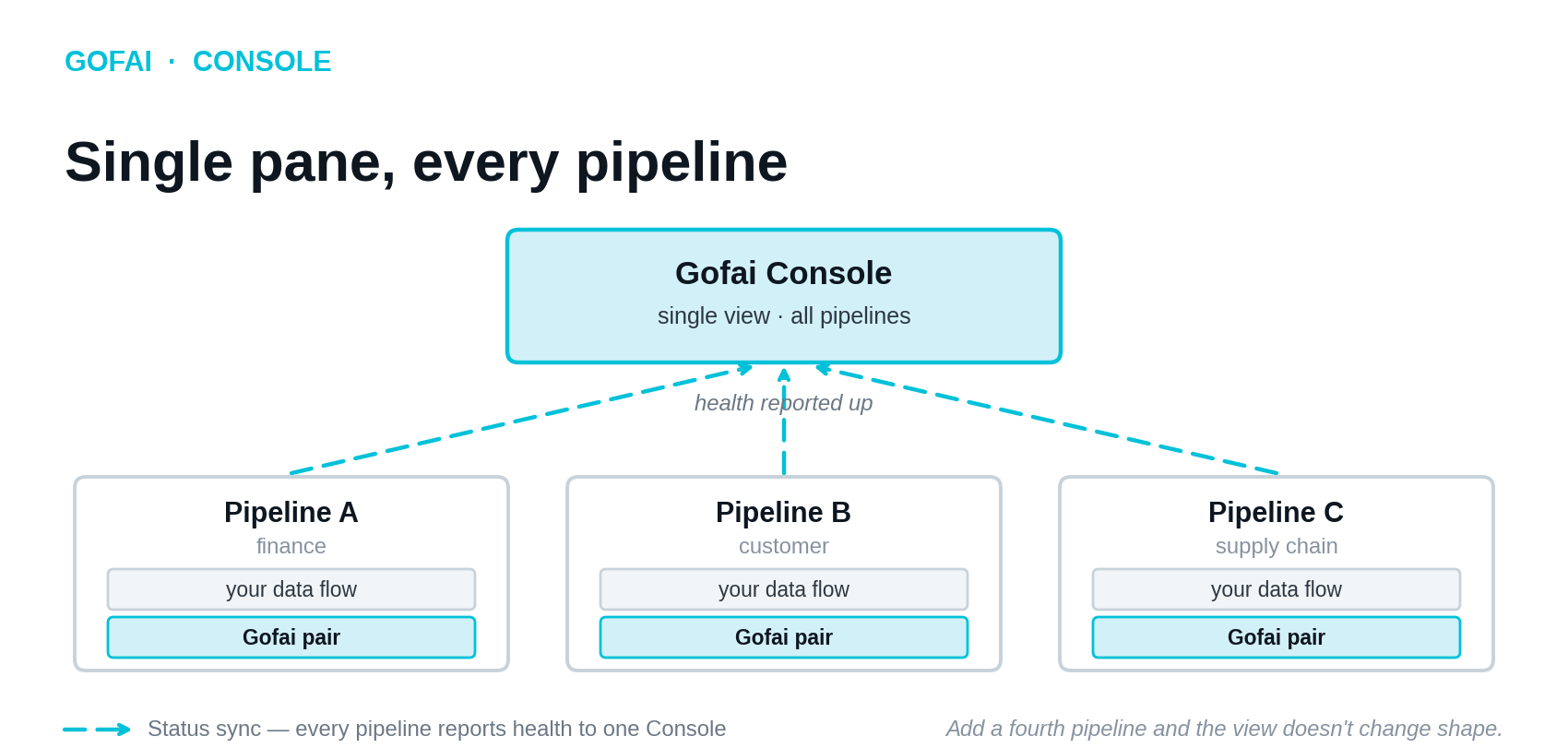
Each pipeline keeps its own Gofai pair. All of them report into one Console. Add a fourth pipeline and the view does not change shape.
Single pane, every pipeline.
However many pipelines run, and wherever they run, stewards see them in one place.
Routes into existing tools
The Console surfaces pipeline status, the findings queue awaiting steward review, and anomaly alerts, all in one screen. Alerts route into the tools teams already use: Slack and PagerDuty out of the box; Jira, ServiceNow, and Microsoft Teams available on request. Stewards review and confirm findings directly in the Console. Nothing asks anyone to watch a new screen.
Built to pass a security review, not work around it.
Because Gofai runs entirely inside the environment, it inherits the controls already enforced there: no exception process, no new approval to route through security.

Deploys under existing controls
Gofai runs under the environment's own identity and network policies. It introduces no new trust boundaries and requires no exceptions for a security team to carve out.

Read-only against the pipeline
Gofai observes the data flow without sitting in the write path. It cannot alter, delay, or block the data downstream systems depend on.

The owner holds all data and credentials
Gofai brings no storage of its own. It writes only to the location you provision, using scoped, revocable access you grant.

An audit trail you control
Every finding is written to your storage with the rule it was checked against and the derivation that produced it. It can be inspected independently of Gofai, under your own retention policies, and survives Gofai being switched off entirely.
The questions, answered.
See it work on your data
Pick one pipeline. Walk away with Gofai operating it in twenty minutes.

